
Lesson 02 · trade

The trade record and its identifiers

The identifiers that name an executed trade — the counterparties, the instrument, and the codes that let two sides be paired and a reconstruction hang together.

July 8, 2026

← Trade lessons
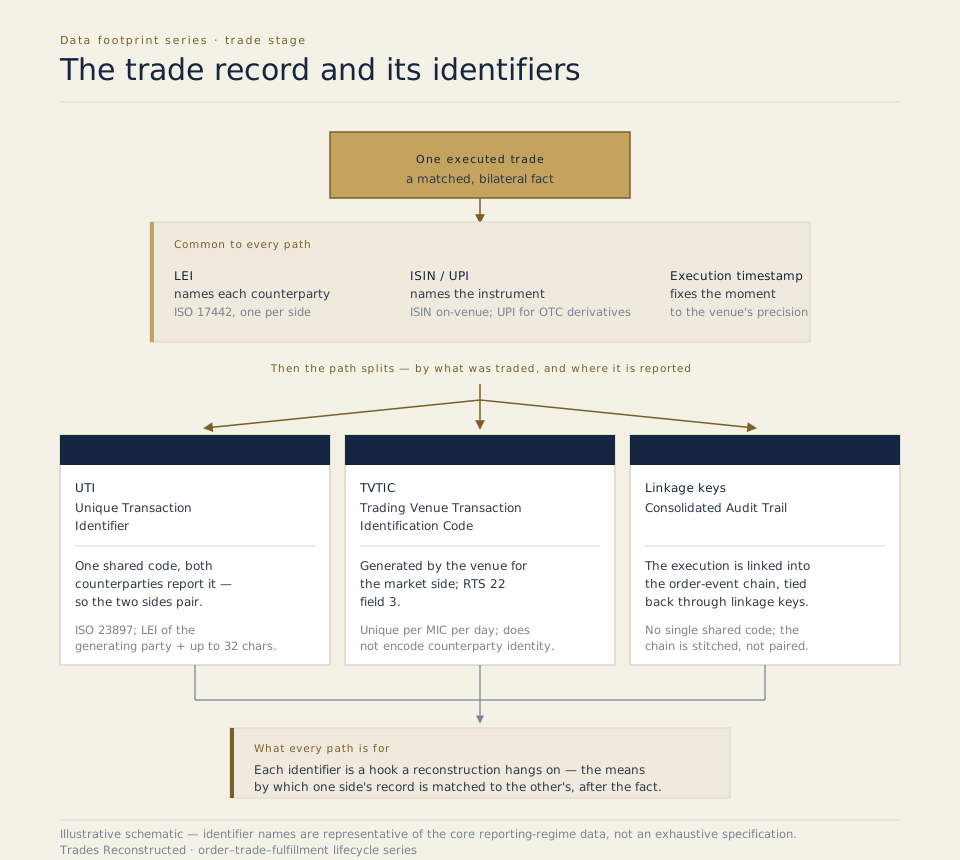
The identifier layer of an executed trade: LEI names each counterparty, ISIN or UPI names the instrument, and the execution timestamp fixes the moment — common to every path. The path then splits: a Unique Transaction Identifier (UTI) for derivatives reported to a trade repository, a Trading Venue Transaction Identification Code (TVTIC) for on-venue equities under MiFIR, and linkage keys for the US Consolidated Audit Trail.
The identifier layer of the executed trade — what is common to every path, and where the path splits by what was traded and where it is reported.

A trade is a fact shared by two parties, and its identifiers exist to make that shared fact provable. Where the order record named an instruction, the trade record has to name a completed, bilateral event — one that two counterparties, and often two regulators, must each be able to point to as the same thing.

Three identifiers are common to almost any executed trade. The Legal Entity Identifier (LEI) names each counterparty. The International Securities Identification Number (ISIN) — or, for many derivatives, the Unique Product Identifier (UPI) — names the instrument. The execution timestamp fixes the moment. Together they answer who, what, and when; but none of them, on its own, names the transaction, and it is naming the transaction that makes reconstruction possible.

Here the path splits by what was traded and where it is reported. For derivatives reported to a trade repository, the transaction is named by a Unique Transaction Identifier (UTI): a single code that both counterparties must report against their own side of the trade — so a regulator can pair two independently submitted records and confirm they describe one trade. Because only one side can create that shared code, a fixed order of precedence (known as the generation waterfall) decides who does: for a centrally cleared trade the clearing house generates it, otherwise the trading venue, otherwise the two counterparties agree between themselves, and if they cannot, a deterministic rule based on sorting their identifiers settles it. The rule exists to guarantee exactly one code, generated once, rather than two sides colliding or each waiting on the other. For equities executed on a venue under the Markets in Financial Instruments Regulation (MiFIR), the equivalent is the Trading Venue Transaction Identification Code (TVTIC), generated by the venue for the market side of the execution. In the United States, no single shared code is used at all; instead the execution is linked into the order-event chain of the Consolidated Audit Trail (CAT) through linkage keys, and the record is stitched together rather than paired.

The distinction matters more than it first appears. A UTI is a shared code, so two reports can be matched to each other; a TVTIC is a venue code, so a report can be matched back to the venue's own record; a CAT linkage key ties an execution back up its own chain of order events. Each is a different mechanism for the same purpose — the hook a later reconstruction hangs on. Every auditability question that follows in this Primer depends on these hooks already being understood.

For the practitioner · identifier mapping

The trade-level identifiers, and where they ride. Where a field is carried in a FIX message, the tag is given; where an identifier belongs to a reporting regime rather than the order-execution protocol, the regime is named instead. Requiredness is scoped to the path — a UTI is a trade-repository field, a TVTIC a MiFIR transaction-report field — not a universal one.

IdentifierWhere it ridesNote
Common to every path
counterparty (LEI)Parties — PartyID (448), PartyIDSource (447) = N, PartyRole (452)the Legal Entity Identifier, ISO 17442; one for each side of the trade
instrument (ISIN)SecurityID (48), SecurityIDSource (22) = 4names the instrument for on-venue and admitted-to-trading cases
instrument (UPI)SecurityID (48), SecurityIDSource (22)the Unique Product Identifier, for OTC derivatives not identified by ISIN
execution timeTransactTime (60)the moment of execution, at the precision the venue supports
Derivatives · reported to a trade repository
UTIEMIR / MiFIR — trade-repository fieldUnique Transaction Identifier, ISO 23897: the generating party's LEI plus up to 32 characters. Shared by both counterparties so their reports pair
On-venue equity · MiFIR transaction report
TVTICMiFIR RTS 22 — field 3generated by the venue for the market side; unique, consistent, and persistent per MIC per trading day; must not encode counterparty identity
venue (MIC)LastMkt (30) / RTS 22 field 36the market identifier code of the execution venue
United States · Consolidated Audit Trail
CAT linkageCAT — reported event, not an order-message fieldthe execution is linked into the order-event chain through CAT linkage keys, rather than named by a single shared code

Sources: FIX Trading Community, FIXimate tag dictionary; EMIR / MiFIR technical standards on transaction reporting (RTS 22); CAT NMS Plan.

Responses from readers

This website does not host open comments. Verified responses are published here at the editor's discretion. Submit a response to editorial@tradesreconstructed.com.