
Lesson 03 · trade

How the trade record is reported

Once a trade is executed and named, its record has to be reported — and where it goes, and whether both sides report it, depends on what was traded. This lesson traces the reporting step that every later reconstruction depends on.

July 12, 2026

← Trade lessons
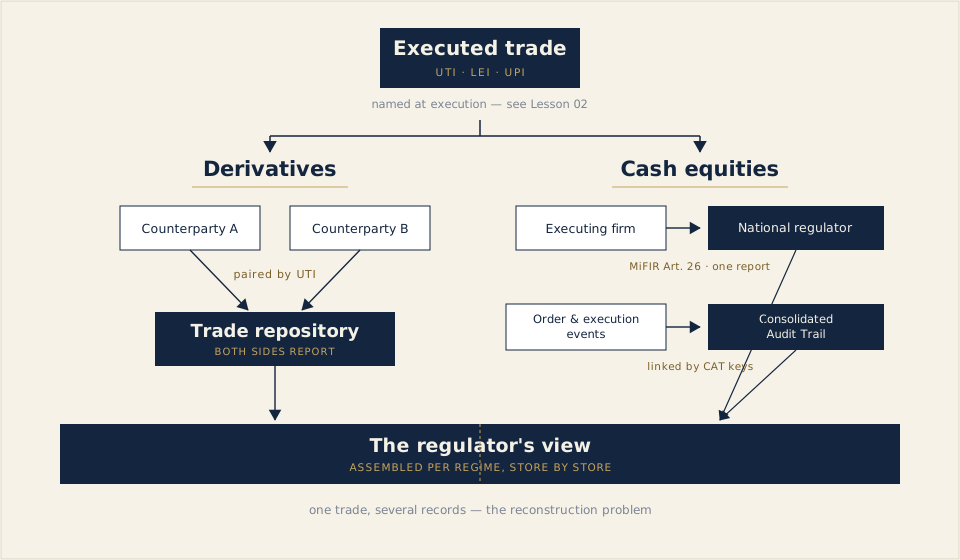
One executed trade splits into two reporting paths. For derivatives, both counterparties report into a trade repository and the two records are paired by the shared Unique Transaction Identifier. For cash equities, the executing firm reports once to a national regulator under MiFIR Article 26, or order and execution events are lodged in the United States Consolidated Audit Trail and linked by CAT keys. Both feed the regulator's view, assembled per regime, store by store.
How one executed trade is reported — two paths, two logics.

A finished trade does not stay private between the two firms that struck it. Each side has to hand a record of it to a regulator — sometimes directly, sometimes into a shared store called a trade repository — so the market can be watched and, when needed, reconstructed. Where that record goes, and whether both sides report it, depends on what was traded.

A trade earns its identifiers at the moment of execution — the codes that name the deal, the product, and the parties, set out in the lesson on the trade record and its identifiers. Reporting is the step that follows: the named record is submitted so authorities can aggregate it, watch the market, and, when needed, reconstruct events. Which route it takes depends on the instrument.

For derivatives, the record goes to a trade repository, a central store built for the purpose. Its defining feature is that both counterparties report, each from its own side. The shared Unique Transaction Identifier (UTI) is what lets a regulator pair those two independent reports into a single trade. That two-sided design is the source of much of the reconciliation effort that follows: when the two sides disagree, the reports fail to pair.

Cash equities take a different route. In Europe, the executing firm reports the transaction to its national regulator under Article 26 of the Markets in Financial Instruments Regulation (MiFIR) — one report, from one side. In the United States, order and execution events flow into the Consolidated Audit Trail, linked by keys rather than paired by a UTI. The same event, lodged in different stores under different logic.

Whatever the route, the reported record is a standardized set of fields — for derivatives, the globally harmonized Critical Data Elements — so that authorities can aggregate across firms and repositories. That aggregation is the whole purpose, and its limits, once a trade crosses borders, are the subject of the essay The codes travel; the data stays home.

For the practitioner · where the record is reported

Where the trade record is reported, and by whom — the destination and the number of sides that report both turn on the instrument and the regime. Two-sided reporting is what makes derivatives reconciliation costly: each side's report has to match on the shared UTI, and lifecycle events are rejected when identifiers or timestamps disagree.

RegimeReported to · by whomPairing key
Derivatives · reported to a trade repository
EMIR (EU)Trade repository — both counterpartiesUTI: the shared code both sides report, so the two records pair
UK EMIRTrade repository — both counterpartiesUTI: the UK regime mirrors EMIR on its own timeline and fields
Cash equities · transaction report (EU / UK)
MiFIR Art. 26National competent authority — executing firmTVTIC plus the report's own reference — one report, from one side
Equities and listed options · United States
CATCentral repository — reporting members, event by eventCAT linkage keys: the execution is linked into its order-event chain, not paired

Sources: EMIR and UK EMIR reporting technical standards; MiFIR RTS 22 (transaction reporting); CAT NMS Plan.

Responses from readers

This website does not host open comments. Verified responses are published here at the editor's discretion. Submit a response to editorial@tradesreconstructed.com.